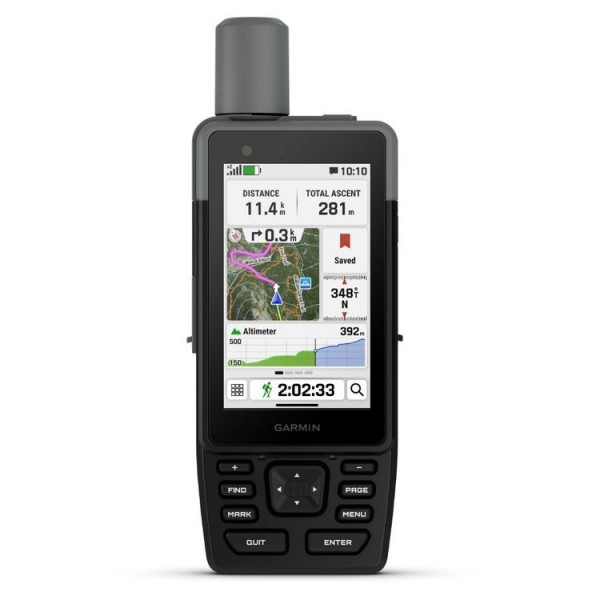
The H1 is Garmin’s current premium handheld GPS (no built-in inReach satellite messenger). If you need SOS and two-way satellite text from the same brick, that is the H1i Plus. The standard H1 is the navigator: maps, tracks, sensors and a screen you can read with gloves on.
Hybrid controls are the big usability win. You get a 3.5" transflective colour touchscreen (282 × 470) behind chemically strengthened glass, plus physical buttons. Wet hands, cold mornings, dusty cape tracks — you can still page maps and mark a waypoint without fighting a phone-style slab.
It is built to MIL-STD-810 (thermal, shock, water) and rated IP67. USB-C charging. Internal lithium battery. Spine Mount 2 on the back with a removable carabiner so it clips to a pack or dash mount.
Navigation that does not need phone coverage
This is why people still buy a Garmin instead of “just using Maps.”
- Multi-band, multi-GNSS — GPS, Galileo, BeiDou, QZSS, NavIC/IRNSS and GLONASS, with multi-band frequencies and SatIQ so the unit can stay accurate in steep country and under light canopy.
- Preloaded TopoActive maps — terrain, contours, trails, parks, hydrography. Routable for outdoor travel, not just a pretty picture.
- Satellite imagery can be sent straight to the device.
- Outdoor Maps+ is the optional subscription if you want ongoing premium map updates.
- 64 GB on board, plus a microSD slot up to 1 TB for extra maps and custom tiles.
- Unlimited courses, GPX import, RINEX logging if you are that way inclined.
Pair it with the Garmin Explore app over Wi-Fi or Bluetooth and you can plan the trip at home, push routes to the unit, then leave the phone in the glovebox.
ABC sensors do the work phones fake with baro-from-the-cloud:
- Barometric altimeter for real elevation
- Barometer for incoming weather trend
- Tilt-compensated 3-axis compass that still points when you are standing still
Battery and “will it last the trip?”
Garmin quotes up to 145 hours in all-systems + multi-band GPS mode with SatIQ, and up to 840 hours in Expedition mode.
That is the difference between a handheld and a phone. A phone GPS weekend is a power-bank project. The H1 is closer to “charge it before you leave Perth and stop thinking about it until you are home.”
Safety extras (not a PLB)
The H1 is not an EPIRB or a PLB and it is not an inReach. What it does give you on the unit itself:
- Bright LED torch / beacon
- Loud built-in safety siren
- LiveTrack through Garmin Connect when a paired phone has coverage, so someone at home can see where you are
For remote WA, the Kimberley or anything past the last bar of Telstra, pair this with a GME PLB (or step up to the H1i Plus if you want messaging in the same device). Navigation and distress beacon are still two jobs.
Who it is for
Buy the H1 if you:
- Walk, hunt, tour or 4WD off the bitumen and want a dedicated GPS that works when the phone is dead or out of range
- Want buttons and a colour map screen
- Already live in Garmin Explore / Connect
- Do not need satellite text built in
Look at the H1i Plus instead if you:
- Want inReach two-way messaging and SOS from the same unit
Keep a phone + PLB instead if you:
- Only ever stay on marked tracks with coverage and already carry an Accusat
Quick specs
| GPSMAP H1 | |
|---|---|
| Display | 3.5" colour touchscreen, 282 × 470, sunlight-readable |
| Controls | Touch + physical buttons |
| GNSS | Multi-band, multi-constellation |
| Maps | TopoActive preloaded, sat imagery, Outdoor Maps+ optional |
| Sensors | Altimeter, barometer, 3-axis compass |
| Battery | Up to 145 hrs GPS / 840 hrs Expedition |
| Durability | IP67, MIL-STD-810 |
| Memory | 64 GB + microSD to 1 TB |
| Size / weight | 6.7 × 17.9 × 3.3 cm / 276 g |
| Ports | USB-C, Bluetooth, Wi-Fi, ANT+ |
| In the box | H1, carabiner, charge/data cable, docs |
Bottom line
The GPSMAP H1 is Garmin doing the simple thing well: a tough handheld that shows you where you are, where you have been, and how to get back, without begging for mobile coverage.
If you already sell or carry Uniden / GME comms and a PLB for the same customers, this is the navigation piece that sits next to them — maps and sensors on the dash or pack, radio for the convoy, beacon for the worst day.
Related Products